SwissMiniGun
Three SecondsThe SwissMiniGun is a miniature, six-shot revolver whose small size makes it possible for Piet Hoffmann to hide it in an unlikely place, but does not diminish its lethal capacity. Hoffmann dismantles the weapon, conceals its components inside a library book, and later reassembles it in prison. Its movement from gun cabinet to book and back again makes the revolver a concrete link between his advance planning and the crisis in which he uses it.
Identity and Design
The SwissMiniGun is described as the world’s smallest revolver, no larger than a car key. Hoffmann bought several directly from the factory in La Chaux-de-Fonds the previous spring. Each carries six-millimeter bullets, and he knows that even a few grams of metal and ammunition can end a life. Its unusual scale is not a matter of harmless novelty: it is small enough to be concealed, yet powerful enough to function as a real firearm.
The gun’s size also creates a practical problem. At first, the trigger guard is too small for Hoffmann to fit his index finger through. He closes the kitchen door and cuts away both ends of the guard with a hacksaw blade. When he tries the altered weapon, holding it between two fingers and aiming at the dishwasher, he still judges it too large for the concealment he needs. The SwissMiniGun has to become smaller still—not through a change in its basic design, but through disassembly.
Disassembly and Concealment
Hoffmann takes the revolver apart with a minute screwdriver that recalls one kept beneath his grandmother’s sewing machine in Kaliningrad. Working carefully over the kitchen counter, he removes the grip screws and taps out a pin. The gun separates into six main components: the two sides of the grip, the frame with its barrel, cylinder pivot and trigger, the cylinder containing six bullets, a barrel protector, and a small unnamed frame part. He keeps the pieces together in a plastic bag rather than leaving a working gun intact.
The dismantling occurs alongside preparations involving other materials. Hoffmann puts the gun parts, eighteen metres of pentyl fuse, and four centilitres of nitroglycerine behind the spare tire in a car, on top of 950,000 kronor in a brown bag. Later, at the Hoffmann Security AB office on Vasagatan, he brings down six seldom-borrowed Aspsås Library books marked for storage, the bag of revolver parts, cut fuse, and a plastic sleeve containing nitroglycerine divided into pockets. His children, Hugo and Rasmus, watch cartoons in the office while he works nearby. The contrast is practical rather than explanatory: the concealed equipment and an ordinary family visit occupy the same workplace.
Hoffmann cuts rectangular cavities into two of the books. In Nineteenth Century Stockholm, he places the revolver components, including the six-shot cylinder, which proves wider than he expected and has to be pressed carefully into the space. In The Marionettes, he hides a small detonator and receiver. Other books are prepared to conceal amphetamine; one account describes four books carrying a total of forty-two grams. The books disguise separate elements of the operation as items an inmate might borrow, allowing the weapon to travel as fragments rather than as an assembled firearm.
The revolver also carries a precedent for its use. Hoffmann recalls seeing one six months earlier at the ferry terminal in Świnoujście, where Mariusz used a miniature revolver against a drug courier. The memory establishes that Hoffmann has seen this particular kind of weapon employed in a killing before he makes it part of his own prison preparations. It gives the tiny gun a history of practical violence, not merely a theoretical capacity to fire.
Reassembly in Aspsås Prison
After entering Aspsås Prison, Hoffmann is held in a five-square-metre cell for twenty-three hours of each day. The confinement restricts movement and contact, while the cell’s door and peephole make the setting part of a tightly controlled routine. Ten days have passed by the time he is shown the unit and learns its rules. He positions himself in the television corner before the other prisoners return, deliberately making his arrival visible and taking a place in the unit’s informal social order.
The weapon’s concealed form becomes important when Hoffmann is in isolation. He retrieves two books, Nineteenth Century Stockholm and The Marionettes, whose covers are marked for library storage. Pulling the first apart, he finds the revolver components arranged in the cut-out margin. The pieces have to be assembled again; the account describes eleven parts in this recovered arrangement, including the frame, barrel, cylinder, grip sides, and small pins. Hoffmann uses the same tiny screwdriver to fit them together, then checks the six bullets and tests the trigger. With the guard already sawn away, the mechanism works: the hammer moves and the revolver produces a sharp click.
The second book yields the detonator, receiver, fuse, and nitroglycerine concealed within its covers. These items are not part of the revolver itself, but their proximity shows how the books serve as containers for a larger cache of equipment. The SwissMiniGun’s usefulness depends on the sequence: it must first be made into separate pieces, then hidden, recovered, and restored to working order within the prison’s restrictions.
Use and Narrative Significance
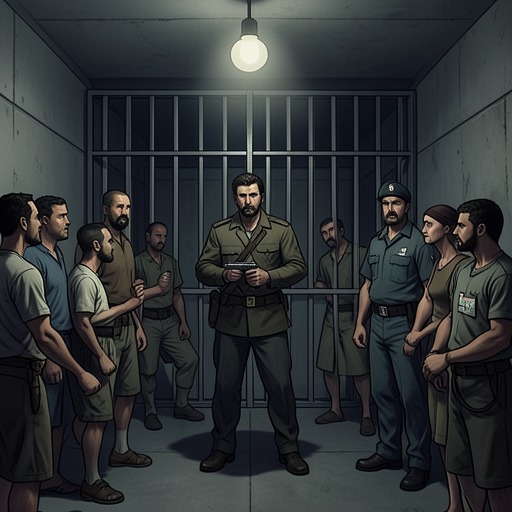
When the warden opens the cell door, Hoffmann moves forward and presents the miniature revolver, holding it to the guard’s eye through the hatch. He uses the weapon to force the door-side confrontation and refers to the guard’s colleague. Later, during the hostage crisis, Stefan rushes toward him despite the weapon. Hoffmann fires one round and then a second as Stefan falls. The revolver, initially prepared as a hidden means of protection, becomes the instrument of a fatal choice in a moment when Hoffmann’s plan to exchange hostages has failed.
The firearm’s smallness shapes both its concealment and the danger it creates. Its components can fit inside a hollowed library book, but once reconstructed it can be raised and fired. A National Task Force officer later identifies the weapon described by guards as probably a SwissMiniGun, noting its six-shot capacity and its reputation as the world’s smallest gun. That recognition confirms the object’s distinctive identity amid the confusion of the prison response.
Across these appearances, the SwissMiniGun is never merely a miniature curiosity. Hoffmann’s work on the trigger guard, the careful separation of parts, the book cavities, and the successful reassembly all turn its physical dimensions into elements of a plan. Yet the final confrontation makes the limits of planning visible too: a weapon prepared for survival does not preserve the intended course of events, and its use leaves a death behind. The gun’s narrative significance rests in that double function—as a carefully concealed tool and as the point where calculated preparation meets irreversible violence.